Bead, Roll, Clear: How to Read a Sporty Lens Coating in British Rain
Photo: Famartin, CC BY-SA 4.0, via Wikimedia Commons
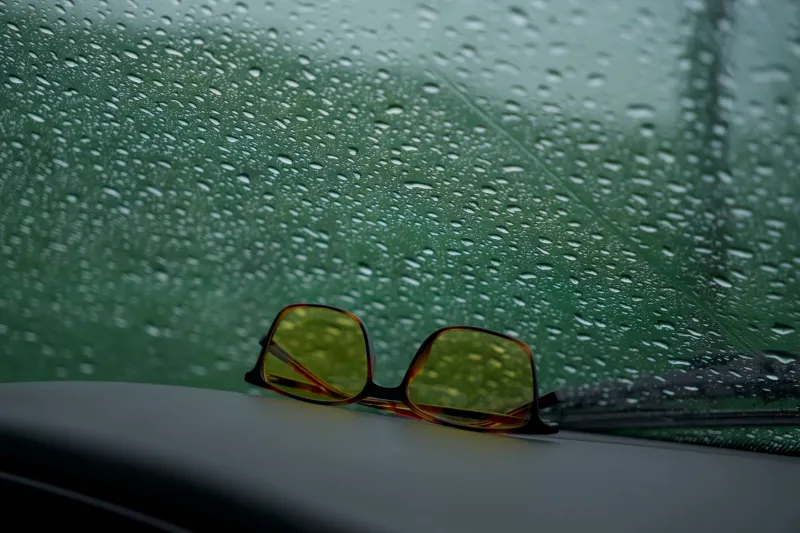
British winter has a particular talent for putting water exactly where you don’t want it. It hangs in the air as fine drizzle, kicks up from wet tarmac as road spray, and settles on your lenses the moment you stop moving. For sporty shades, the difference between a clear view and a smeary one often comes down to a finish you can’t really see: the hydrophobic and oleophobic coatings sitting on top of the lens.
This isn’t about making a pair of sunglasses sound invincible. It’s about understanding what those coatings do, what they don’t do, and how to tell whether the pair in your hand is pulling its weight on a damp November morning.
What the coatings are actually doing
A hydrophobic coating encourages water to gather into compact beads rather than spread into a flat film. On a good surface, droplets sit up, roll away more easily and leave less behind when you give the frame a gentle shake. That matters when you’re running into a headwind, cycling through a puddle-strewn lane or waiting for a bus with rain blowing sideways.
Oleophobic coatings deal with the oilier side of life: fingerprints, sunscreen, moisturiser and the general grime that builds up around the nose bridge and temples. The two finishes are often paired because real-world lenses face both water and oil. A lens that sheds rain but holds onto every thumbprint is only half useful.
On sporty Oakley-style frames, these finishes are usually applied as thin treatments over the lens surface. They are not a magic shield. They wear with time, dislike harsh cleaners and can be compromised by grit trapped in a cloth. But when they are intact, they change how you maintain a clear view in wet weather.
Coated versus uncoated: the everyday difference
Uncoated lenses are not useless. Many basic tinted lenses will keep glare down and look perfectly good in dry conditions. The trouble starts when water sits on the surface. Instead of beading, it tends to flatten out, creating a patchy film that catches streetlights, headlamps and low winter sun in awkward ways. You wipe, it smears, you wipe again.
A coated lens usually gives you a little more time before that happens. Rain beads up, spray slides off more readily and a quick dab with a clean microfibre cloth is more likely to leave a clear surface. The effect is especially noticeable on a commute where you move between exposed pavement, a humid train carriage and a brightly lit office. It is also useful on weekend runs where you may be breathing hard, sweating around the nose pads and dealing with drizzle all at once.
The catch is that coatings vary. A cheap hydrophobic layer may feel effective for a few weeks and then fade. A better-applied finish, paired with sensible care, tends to keep its behaviour for much longer. That is why two pairs with similar tints can feel completely different in the rain.
The at-home bead test
You don’t need lab equipment to get a rough idea of what your lenses are doing. A simple bead test is best done indoors, with clean hands and a lens that is already free of grit.
First, rinse the lens under a gentle tap. Don’t use hot water and don’t blast it at high pressure. Watch how the water behaves. On a freshly coated surface, it should form distinct droplets and run off in fairly tidy lines. On an older or uncoated lens, water may cling in broad patches or leave a broken film.
Second, give the frame a small shake over the sink. A coated lens will usually shed more water than an uncoated one. That doesn’t mean it will be perfectly dry, but the difference should be visible. If the surface looks uniformly wet and reluctant to release anything, the coating is either absent or no longer doing much.
Third, test the oily side. After the lens has dried, press a clean finger lightly onto the surface and look at the mark. A decent oleophobic finish makes fingerprints easier to buff away with a microfibre cloth. If the mark spreads and smears stubbornly, the oil-repellent side of the coating is weak or worn.
One test on one cold morning won’t tell you everything. Repeat it occasionally, especially before a wet-weather event or a long ride. The trend matters more than a single result.
Care rules that keep the finish alive
Coatings don’t fail dramatically. They fade through small habits. The biggest offender is wiping a dirty lens with a dry cloth. Grit and dust act like fine sandpaper, and every firm swipe takes a little more life out of the surface.
Rinse first whenever possible. A quick run under lukewarm water lifts loose dirt before you touch the lens. Then use a clean, dedicated microfibre cloth and light pressure. Avoid kitchen roll, tissues, shirt sleeves and anything that has been washed with fabric conditioner, as these can leave residue or scratch.
Skip hot water, alcohol-heavy cleaners and household glass sprays unless the manufacturer explicitly says they are suitable. Store the shades in a case rather than loose in a bag, and try not to leave them on a car dashboard where heat and UV can be unkind to both frame and coating. If your lenses have been in the rain, don’t seal them away wet for hours; let them air dry in a safe place first.
When an upgrade is genuinely worth it
A coating upgrade makes most sense if you wear your shades in wet conditions often. Cyclists, runners, commuters who walk a decent stretch to the station and anyone who spends weekends outdoors in the UK will feel the benefit more than someone who mostly wears sunglasses for a sunny pub garden.
It is also worth paying for if the base lens is already good. There is little point putting a premium finish on a tint that gives you eye strain or a frame that doesn’t fit properly. Fit comes first, lens quality second, coating third.
If you only wear shades occasionally, or if your current pair is old and scratched, a coating upgrade may be money better put toward a new set. Coatings work best on a healthy surface. Once the lens is scuffed, even a good hydrophobic finish can only do so much.
The sensible approach is to treat the coating as part of the lens, not an afterthought. Ask what is on the surface, how it should be cleaned and whether it suits the way you actually use your shades. In a British winter, that small layer of slickness is often the difference between squinting through smears and getting on with your day.